
LONE STAR BRASS
AMERICAN VOICES: FROM GERSHWIN TO THE MOUNTAINS
Tuesday, March 24, 2026 | 7:30 PM
Rea-Greathouse Recital Hall at WNPAC
Four Sketches (1989)
Anthony Plog (b. 1947)
I. Allegro
II. Allegro vivace
III. Andante
IV. Allegro
Anthony Plog (b. 1947) is an American trumpeter and composer whose career has spanned orchestral performance, chamber music, solo touring, teaching, and composition. A native of Glendale, California, he studied at the University of Southern California, California State University, and the Music Academy of the West. At just 19, he began performing as an extra with the Los Angeles Philharmonic under conductors such as Zubin Mehta, James Levine, Michael Tilson Thomas, and Claudio Abbado. He later served as Principal Trumpet of the San Antonio Symphony and Associate Principal of the Utah Symphony before pursuing a solo and composition career.
Plog performed and recorded extensively throughout the United States, Europe, Australia, and Japan, and was a founding member of the Fine Arts Brass Quintet and Summit Brass. In 1990 he moved to Europe, serving as professor at the Staatliche Hochschule für Musik in Freiburg, Germany, and performing with several major European orchestras. Since retiring from the concert stage in 2001, he has devoted himself fully to composition; his works have been performed in more than 30 countries and commissioned by leading ensembles worldwide.
Four Sketches (1989), commissioned by Mel Jernigan and the St. Louis Brass Quintet, showcases Plog’s command of color and rhythm. With the exception of the lyrical third movement, the work is rhythmically driven, exploring the full timbral range and expressive possibilities of the brass quintet.
Timepieces (1997)
Douglas Hill (b. 1946)
I. Good Times
II. Upon a Time
III. Another Time
IV. Simpler Times
V. Party Time!
Douglas Hill composed Timepieces for Brass Quintet in the summer of 1997 to celebrate the 25th anniversary of the Wisconsin Brass Quintet and his tenth year as the group’s hornist. Though Hill created numerous brass quintet arrangements, this five-movement, jazz-inspired work is his only original composition for the medium. It was premiered on October 18, 1997, at the University of Wisconsin–Madison.
Built around seven original melodies, Timepieces unfolds in five movements—“Good Times,” “Upon a Time,” “Another Time,” “Simpler Times,” and “Party Time!”—each evoking distinct moods and jazz styles. From the playful Dixieland exuberance of the opening movement to the lyrical warmth of “Simpler Times” and the rhythmic vitality and salsa-infused energy of the finale, the suite offers a celebratory tribute to shared memories, camaraderie, and the joy of making music together.
INTERMISSION
Three Preludes
George Gershwin (1898 – 1937)
I. Allegro ben ritmato e deciso
II. Andante con moto e poco rubato
III. Allegro ben ritmato e deciso
In the mid-1920s, Classical music, or what he referred to as “serious” music, was very much on George Gershwin’s mind. He was already one of the most successful composers on Broadway when his Rhapsody in Blue premiered in 1924, a groundbreaking fusion of Jazz and Classical styles. He followed up with two equally successful orchestral pieces, the Concerto in F (1925) and An American in Paris (1928). While on an extended visit to Paris, he sought composition lessons from Nadia Boulanger, Igor Stravinsky, and Maurice Ravel. All of them turned him down, with Ravel asking: “Why become a second-rate Ravel when you’re already a first-rate Gershwin?”
Gershwin also tackled smaller Classical forms during the 1920’s. In 1925, he wrote several piano preludes. He had originally planned to do a set of twenty-four, but the always-busy Gershwin finished only seven of them, playing five of these on a recital at New York’s Hotel Roosevelt on December 4, 1925. In the end, he published three of the preludes as a set in 1926.
Three Preludes is still widely performed by pianists today, but is also adapted for many other ensembles, as in this arrangement for brass quintet by Bill Holcomb. All three of the preludes have Gershwin’s typical jazz style. The main theme of Prelude No.1 is a bluesy theme stated by the trumpet, with a brief flashy passage for trombone as contrast. All of this is set above a repeating Brazilian rhythm. Prelude No.2 sings the blues, with a laid-back theme for the trumpets, and a soulful tuba solo in the middle. Prelude No.3 begins with a short and frantic introduction before the appearance of the main idea, a syncopated melody with a distinct hint of “stride piano” style. For contrast, there is a short Latin-style episode in the middle.
Adagio
Samuel Barber (1910 – 1981)
When Samuel Barber died in 1981 his name may not have been as familiar to a wide public as George Gershwin’s, or even Aaron Copland’s. But he could equal, or even surpass them, in the success achieved by one of his compositions, the Adagio for Strings: a “crossover” hit long before that expression had gained currency.
The Adagio for Strings is connected with one of the great names in conducting, Arturo Toscanini, who presented its world premiere with his NBC Symphony on a nationwide broadcast (November 5, 1938) and then took it, as the only work by an American composer, on a tour of South America with the orchestra.
It was a success from the start, but not as music for a large string orchestra. The piece began life as the slow movement—marked “Molto adagio”—of Barber’s only string quartet, written in 1936 while its composer was a Fellow of the American Academy in Rome. The premiere of that work compared in glamor to that of the orchestral slow movement two years later, the performers being the Pro Arte Quartet, as celebrated in their intimate world as Toscanini was in his vast arena.
Music of austere grandeur, the Adagio, in the composer’s own arrangement for string orchestra, has become widely associated with solemn occasions, among them the funerals of Franklin Delano Roosevelt, Albert Einstein, and Princess Grace of Monaco. It reached its widest audiences, however, as the background leitmotif in Oliver Stone’s 1986 Vietnam War film Platoon.
Wrong-Mountain Stomp (2018)
John Mackey (b. 1973)
I. Billy, I’m leavin’
II. Mama, I’m leavin’
“Wrong-Mountain Stomp” tells the story of Jenny, a young girl who has spent her whole life growing up in the hills of Appalachia. Jenny has tired of her life there, and she decides to move to “bigger mountains,” specifically, the mountains of Vail, Colorado – the work was commissioned by the Vail Valley Music Festival.
In the first movement, “Billy, I’m Leavin’,” Jenny breaks the news of her departure to her boyfriend, Billy. Jenny and Billy are both terribly sad that Jenny is leaving, but Billy takes the news especially hard – Billy tends to wear his emotions on his sleeve. In the second movement, “Mama, I’m Leavin’,” Jenny gets in a fight with her mama and, well, leaves, slamming the door on her way out.
-
Eric Baker
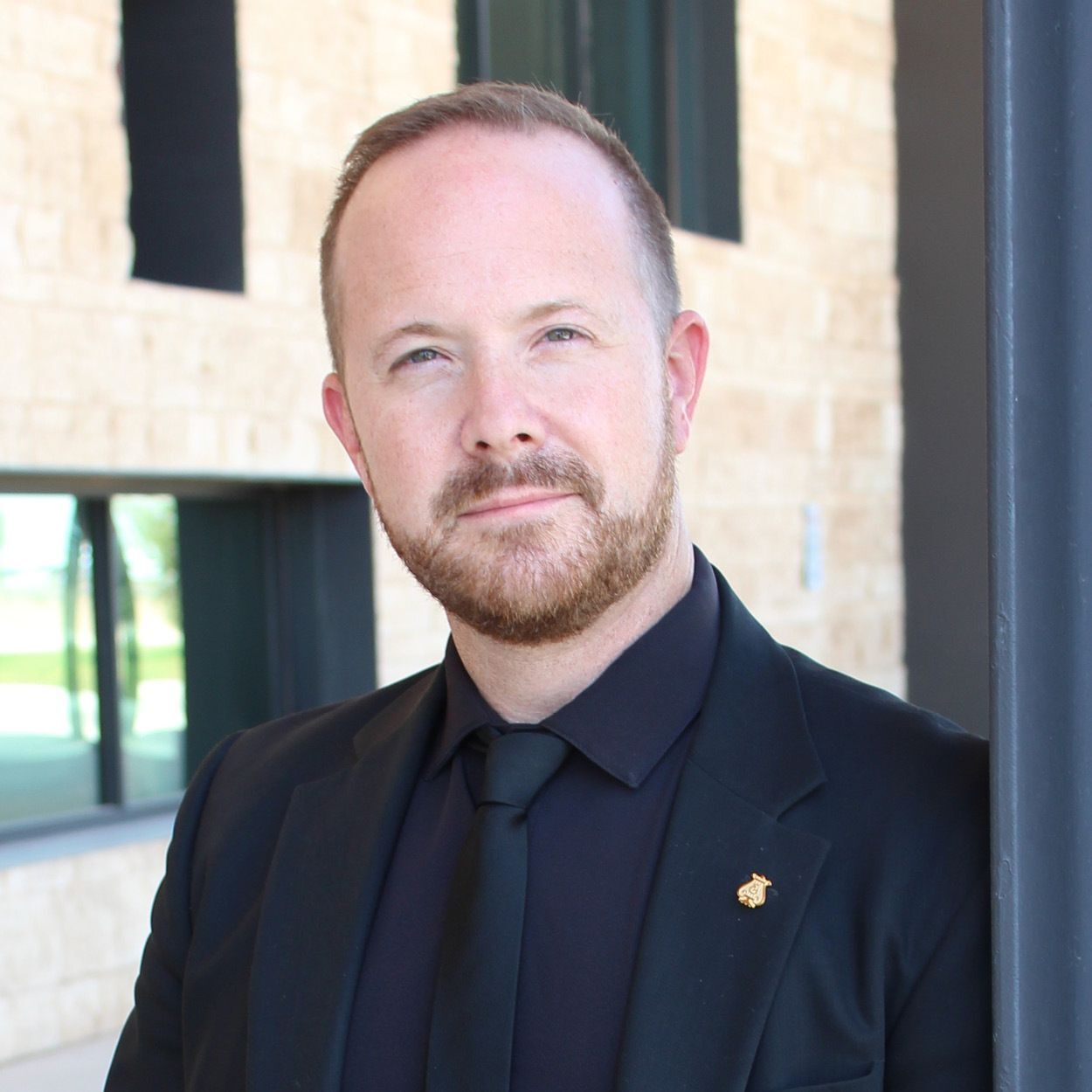
ERIC BAKER - TRUMPET
Eric Baker grew up in Ft. Worth, TX, and began playing the trumpet at age 11. He received his B.M. in Music Education from the University of Texas at Arlington, and earned his Master’s Degree in Trumpet Performance from Arizona State University where he studied with internationally renowned trumpet soloist, David Hickman. Mr. Baker was a member of The Cavaliers Drum and Bugle Corps for three years (2000, 2002, 2003).
Mr. Baker moved to Odessa, TX in July 2006 to begin his tenure as Co-Principal trumpet with the West Texas Symphony. He has also performed with the Big Spring Symphony, and the San Angelo Symphony, the Legend Brass Quintet, the West Texas Trumpet Workshop, and the Salt River Brass Band. He also performs regularly with the Lone Star Brass Quintet, Current Nine, The Pinstripes Jazz Quartet, and Emily & the Rhumba Kings. He performed with the touring production of the hit Broadway musical Chicago, and has performed on stage with The Temptations and The Four Tops. He free-lances all over West Texas, and is a highly sought-after marching band clinician and private teacher.
In 2007 Mr. Baker was invited to be a featured soloist at the Western International Band Clinic in Seattle, WA, and in 2010, he was a semi-finalist for the National Young Artists Competition. In 2011 he performed as a trumpet soloist with the West Texas Symphony, and in 2016 he was invited back to perform with the WTS as a vocal soloist. Mr. Baker appears as a trumpet artist on the albums "What Sweeter Music" and "Rocket Science," and appears on the album "Caleb Young" as a vocalist.
He was appointed to the position of Director of Bands at Odessa College in 2009 where he conducts the Concert, Jazz, and Athletic bands, teaches the trumpet studio, conducts the opera productions, and serves as Chair of Visual and Performing Arts Department. He also serves on the board of directors for Odessa Arts, and the West Texas Jazz Society. His wife, Emily is the director of the WTS Voices of the Permian Basin. They have three daughters, Piper, Keller, and Harper. Mr. Baker is a proud Schagerl Artist.
-
Ben Fairfield
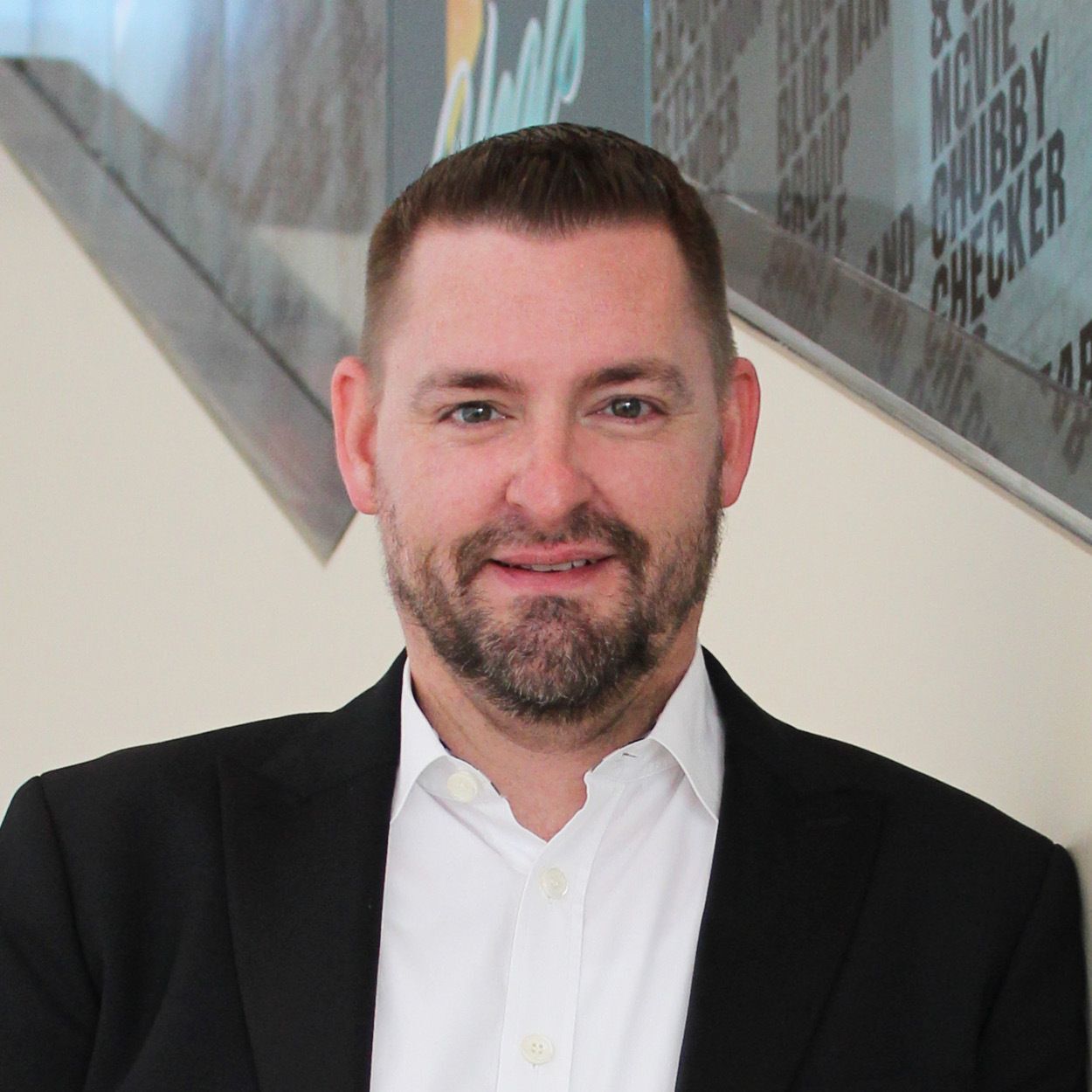
BEN FAIRFIELD - TRUMPET
Ben Fairfield, a native of Staunton, VA, is the Co-Principal Trumpet of the West Texas Symphony, a member of the Symphony’s Lone Star Brass Quintet, and the Principal Trumpet of the Abilene Philharmonic. He is also the Associate Principal Trumpet of the Missouri Symphony in Columbia, MO and a member of the Lone Star Winds in Dallas, TX. He frequently performs as a guest member of the trumpet section with orchestras throughout the United States including the New Mexico Philharmonic, Santa Fe Symphony, Boulder Philharmonic, San Juan Symphony, San Angelo Symphony, and the Waco Symphony. Recent engagements have taken him to New York, NY, Albuquerque, NM, Denver, CO, Miami, FL, Philadelphia, PA, and San Francisco, CA. Prior to his time in Texas, he performed in the orchestras of the Florida Grand Opera and the Miami City Ballet in Miami, FL.
Ben has taught trumpet at Eastern New Mexico University, Auburn University, Barry University, and the University of Miami. He is also a veteran of the United States Army, performing as a member of the United States Continental Army Band at Ft. Monroe, VA. With this group, he performed throughout the United States on tours with both the Concert Band and Brass Quintet. He has performed as a featured soloist with the United States Continental Army Band and several orchestras, performing works ranging from Bach’s Brandenburg Concerto No. 2 to Haydn’s Trumpet Concerto in Eb and Copland’s Quiet City, and with noted opera singers Placido Domingo, Denyce Graves, Ailyn Perez, and Bryn Terfel. He has also performed at the conferences of the International Trumpet Guild, the American Bandmasters Association, the Texas Music Educators Association, the Virginia Music Educators Association, and in many of the nation’s leading concert halls including Carnegie Hall, the Meyerson Symphony Center, the Kennedy Center, and the Arsht Center for the Performing Arts.
In March 2017, Ben and pianist Liana Pailodze Harron gave the New York City premiere of Grammy Award winning composer Michael Daugherty’s The Lightning Fields for trumpet and piano at the 92nd Street Y in Manhattan, NYC. The duo has also worked with Eric Ewazen on his popular Sonata for Trumpet and Piano, with plans to record the sonata in collaboration with the composer in the near future. The duo’s recording of Lucid Dream, an arrangement of Michael Nyman’s Flugelhorn and Piano can be found on iTunes and YouTube.
Ben currently resides in Arlington, TX. He holds a Bachelor of Music Education degree from James Madison University and graduate degrees (MM, DMA) in trumpet performance from the University of Miami Frost School of Music. His teachers include Craig Morris, former Principal Trumpet of the Chicago Symphony Orchestra, Gilbert Johnson, former Principal Trumpet of the Philadelphia Orchestra, and James Kluesner Professor Emeritus of Trumpet at James Madison University.
Ben is a Vincent Bach performing artist, a division of Conn-Selmer.
-
Scott Millichamp
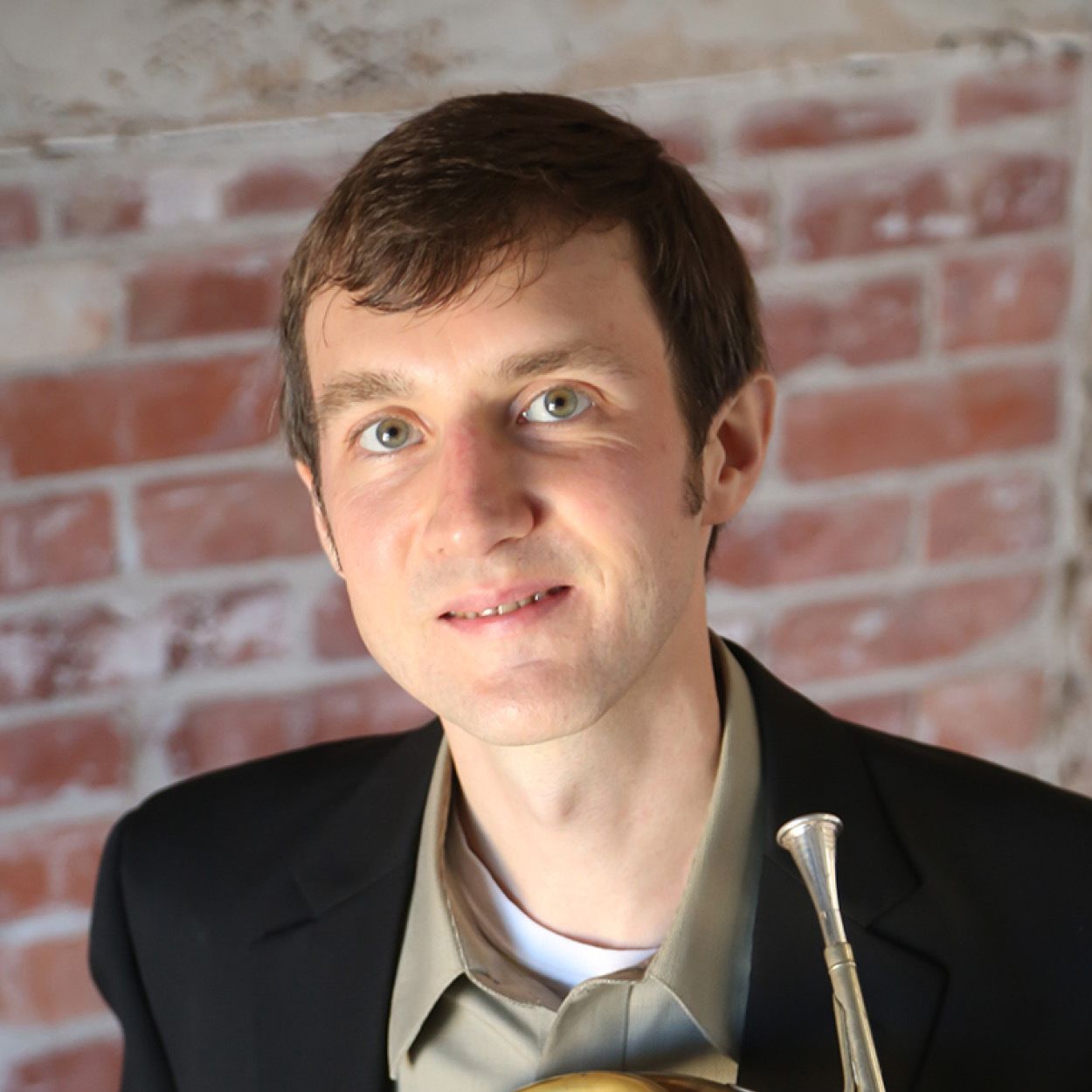
SCOTT MILLICHAMP - HORN
Scott Millichamp is co-principal horn of West Texas Symphony, hornist with WTS's Lone Star Brass quintet, principal horn with Abilene Philharmonic, principal horn with Missouri Symphony Orchestra, co-director of music at Unitarian Universalist Church of Midland, and instructor of horn and composition at UTPB.
A native of Detroit, Scott graduated from Interlochen Arts Academy with a Fine Arts Award in Horn and received his Bachelor and Master degrees in Horn Performance from Indiana University. Following his time at IU, he served concurrently as a graduate teaching assistant in Composition at the University of Hawaii in Manoa, a substitute hornist with the Honolulu Symphony Orchestra, pianist for Honolulu Waldorf School’s Eurythmics classes, and choir accompanist for First Unitarian Universalist Church of Honolulu. Prior to joining the WTS in 2009, he served as fourth horn of Arkansas Symphony Orchestra; he also performed with Opera in the Ozarks festival from 2009-2011, Lyrique-en-Mer opera festival on Belle-Ile (France) in 2008 and 2010, and Glimmerglass Festival in 2023. In 2015 he performed Richard Strauss’s Horn Concerto No. 1 with the West Texas Symphony and Gary Lewis. Scott’s horn and piano composition Crossroads (2000) was recently released on the album At the Crossroads, performed by Patrick Hughes and Colette Valentine and available for purchase or streaming on most music platforms.
For more information visit www.scottmillichamp.com.
-
Stewart Rhodes
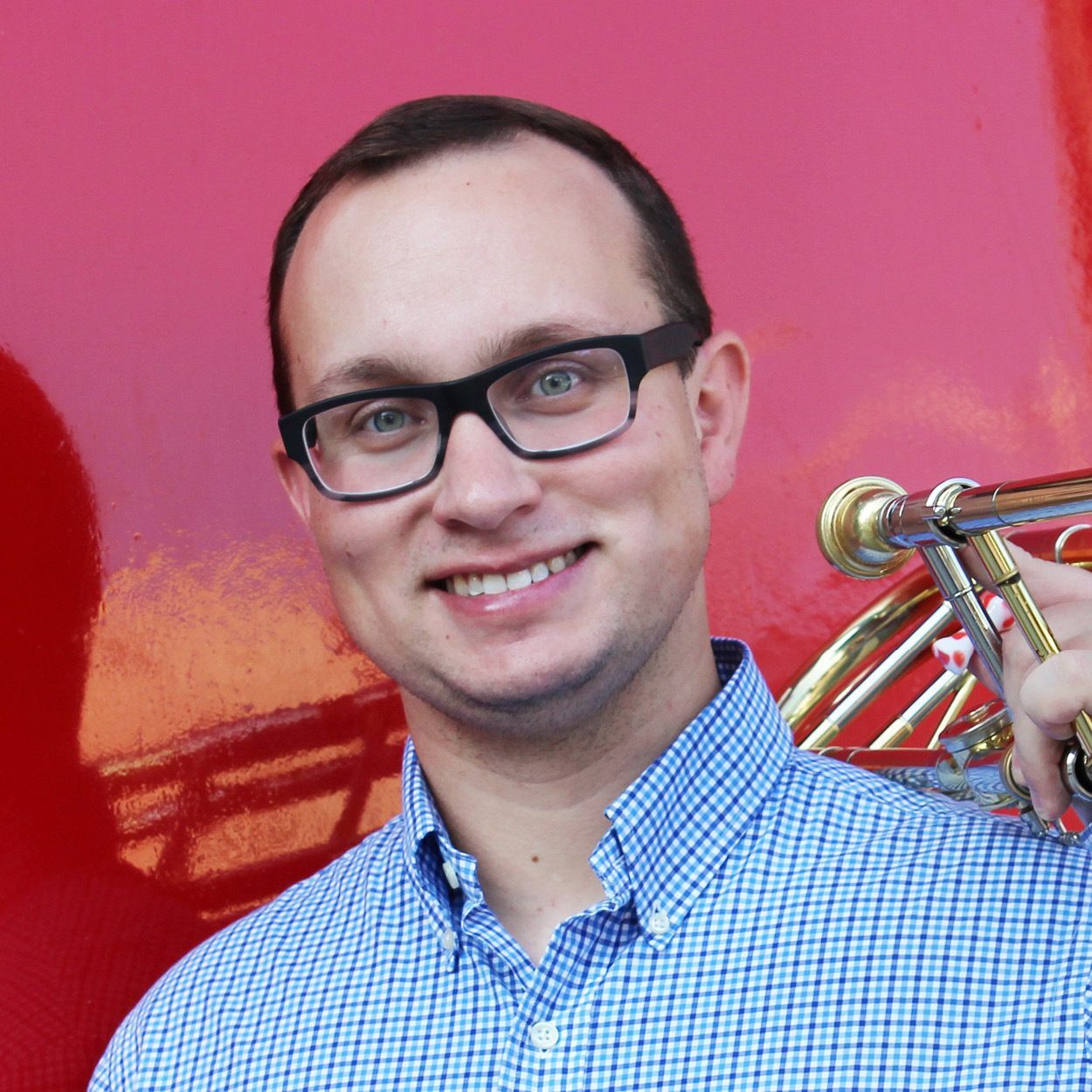
STEWART RHODES - TROMBONE
Stewart Rhodes, a native of Fort Worth, TX, began playing trombone at the age of 11. He received his B.M. and M.M. from Indiana University’s Jacobs School of Music. Mr. Rhodes is currently finishing up his DMA in Trombone from the University of North Texas. Mr. Rhodes’s primary trombone teachers include: James McNair, M. Dee Stewart, Peter Ellefson, Carl Lenthe, Denson Paul Pollard, Natalie Mannix, Tony Baker, and Steve Menard.
Mr. Rhodes moved to Midland, TX in July 2022 to begin his new role as Principal Trombone with the West Texas Symphony and trombonist with the acclaimed Lone Star Brass Quintet. Mr. Rhodes has had the privilege of performing with the Carmel Symphony, the McKinney Philharmonic, the Allen Philharmonic, the Terre Haute Symphony, the Miami Classical Music Festival Orchestra, and the Dallas Winds. He has performed at Jazz at Lincoln Center, TMEA, Normandy (France), London (England), the Meyerson (Dallas, TX), and several other venues around the United States.
Aside from performing, Mr. Rhodes is very active with the educational aspect of music. During his doctoral studies at UNT, he taught several private lesson students from Lewisville ISD, McKinney ISD, Birdville ISD, Cleburne ISD, and Grapevine-Colleyville ISD. His students have gone on to win spots in the TMEA All-Region, All-Area, and All-State Bands. Mr. Rhodes is also a strong proponent for the marching arts and regularly helps out with the marching bands at Birdville High School, Grapevine High School, Colleyville Heritage High School, and Odessa High School. Mr. Rhodes currently serves as the Director of Bands at Crockett Middle School in Odessa, TX and oversees a thriving program of more than 200 middle school band students. Mr. Rhodes hopes to inspire all of his students to be not only great musicians, but well-rounded individuals first and foremost.
-
Parker Burkey
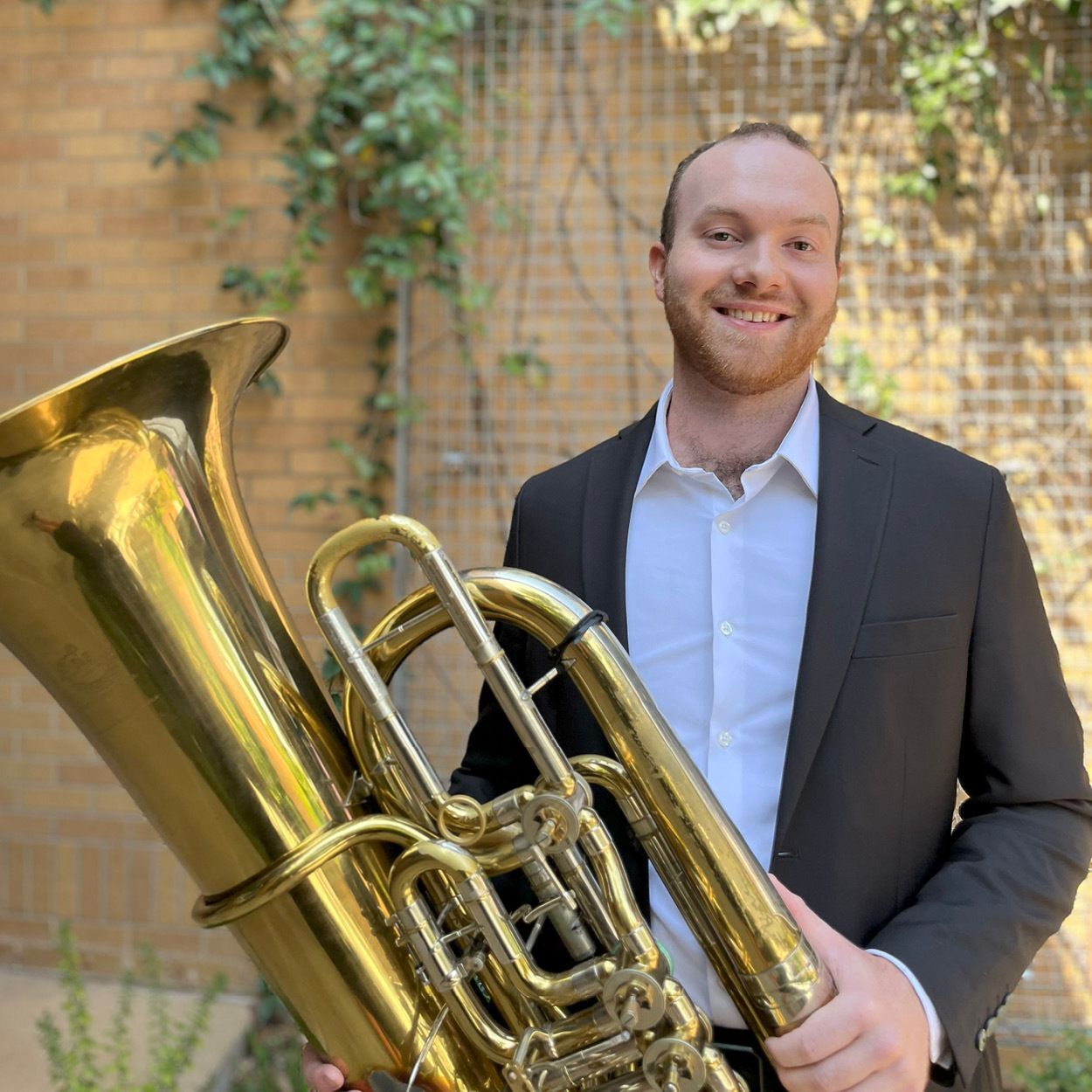
PARKER BURKEY - TUBA
Originally from Grand Junction, Colorado, Parker Burkey earned his bachelor's and master's degrees in tuba performance from the University of North Texas. There, he studied with Donald Little and Matthew Good in addition to teaching his own studio as a graduate teaching fellow. Parker spent the summer of 2025 playing with the Music School Festival Orchestra of the Chautauqua Institution.
Parker is currently Principal Tuba of the West Texas Symphony and tubist of its resident brass quintet, Lone Star Brass.
PROUDLY SPONSORED BY:
Ann Parish & Betty Ann Prentice
FRIENDS OF LONE STAR BRASS:
Audie & Bill Brooks
Denise & Thomas W. Elrod
Dr. Paul Feit
Maridell Fryar
Ann & Ken Hankins, Jr.
Leslie George Millichamp
Ann Parish
Betty Ann Prentice
Violet & Mark Singh
